
Farming and agriculture are hot topics around the world, yet surprisingly little is known about what farming in the EU actually looks like. Did you know that in Europe, more than 9 out of 10 farms are family farms? [i]
So, what exactly is a family farm? The EU uses the FAO definition: "A family farm is an agricultural holding which is managed and operated by a household and where farm labour is largely supplied by that household." [ii] In practice, this means that more than 50% of the work on the farm is carried out by the family members who live on the farm. These farms also tend to be significantly smaller on average than non-family farms, with 11.3 hectares of utilised agricultural area compared to 102.2 hectares for non-family farms [iii].
But smaller does not mean less important. Family farms play a unique and vital role in European food security. Because they operate on smaller, often remote or fragmented land (areas that larger-scale operations typically find unattractive) family farms contribute to farming landscapes that would otherwise go uncultivated [iv]. They are also uniquely motivated: research shows that family farmers weigh environmental factors and family wellbeing alongside financial considerations when making decisions [v]. Growing up on the land they farm, family farmers often develop a deep personal connection to their animals, land, and rural community, making them important stewards of both the natural environment and local communities [vi].
Between 2010 and 2020, Europe lost approximately 3 million family farms [vii]. At the same time, the global demand for agricultural production is expected to increase by as much as 35–56% in the coming decades [viii], placing enormous pressure on all farms, and particularly smaller and medium-scale ones. The rise of digital agriculture (and specifically big data-based tools) offers real opportunities to help farmers respond to these pressures, supporting more holistic decision-making that balances social, environmental, and economic sustainability [ix]. However, many of the digital tools currently on the market come with significant costs, putting them out of reach for smaller farms [x] and risking a growing divide between large-scale and family-scale operations [xi].
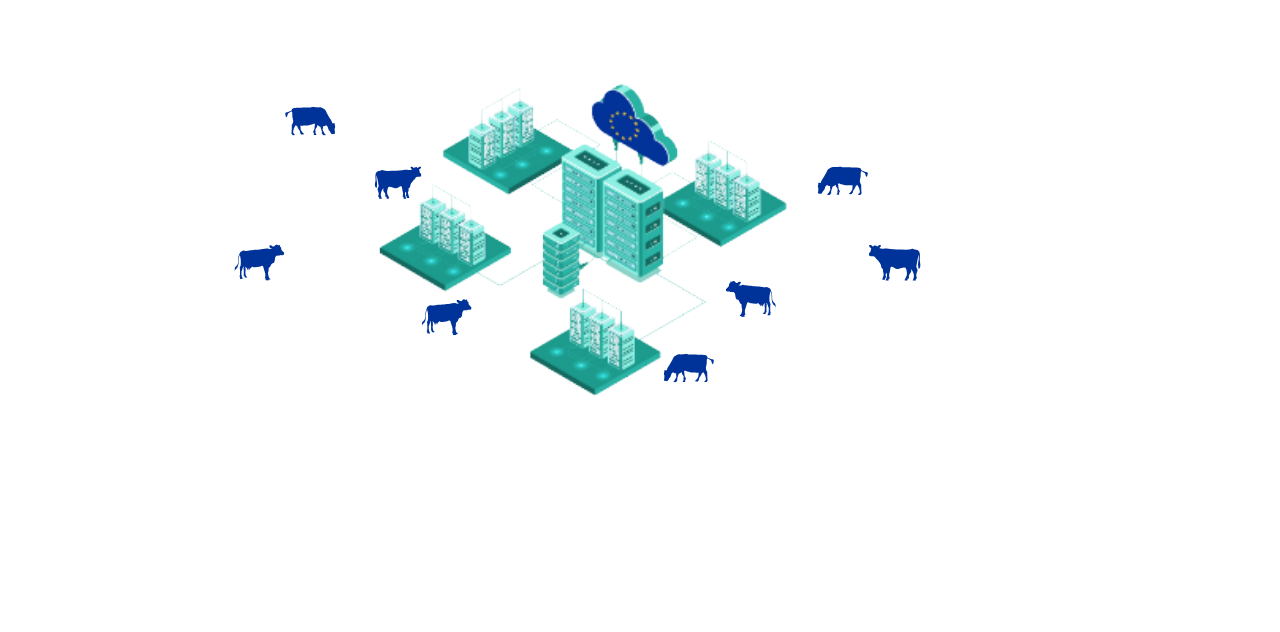
This is where HoliCow comes in. HoliCow was developed in direct response to the decline of small and medium-sized dairy farms across Europe, a decline driven in part by limited access to affordable, practical technology. The project brings together partners committed to changing this, by developing a free HoliCow tool that enables big-data-driven, holistic decision-making specifically designed for small and medium-scale farms. Crucially, the tool is built around data and analyses that farms are already generating, so rather than adding burden, it builds on what already exists to deliver greater value at no extra cost.
The HoliCow tool has been developed through a co-design process, working directly with farmers to ensure it fits the realities of their farms and daily routines. Because a tool is only useful if it actually works for the people using it.
By Ebba Eriksson, Junior Project Manager at EFFAB
[i] Eurostat. (2020). Agricultural Census
[ii] Food and Agriculture Organization. (2013). Definitions and operational perspectives: family farms. Food and Agriculture Organization.
[iii] Eurostat. (2020). Agricultural Census
[iv] Galli, F., Grando, S., Adamsone-Fiskovica, A., Bjørkhaug, H., Czekaj, M., Duckett, D. G., Almaas, H., Karanikolas, P., Moreno-Pérez, O. M., Ortiz-Miranda, D., Pinto-Correia, T., Prosperi, P., Redman, M., Rivera, M., Toma, I., Sánchez-Zamora, P., Šūmane, S., Żmija, K., Żmija, D., & Brunori, G. (2020). How do small farms contribute to food and nutrition security? Linking European small farms, strategies and outcomes in territorial food systems. Global Food Security, 26. https://doi.org/10.1016/j.gfs.2020.100427
[v]
Baldwin, C., Smith, T., & Jacobson, C. (2017). Love of the land:
Social-ecological connectivity of rural landholders. Journal of Rural Studies,
51, 37-52. https://doi.org/10.1016/j.jrurstud.2017.01.012
Gosling, E., & Williams, K. J. H. (2010). Connectedness to nature, place
attachment and conservation behaviour: Testing connectedness theory among
farmers. Journal of Environmental Psychology, 30(3), 298-304.
https://doi.org/10.1016/j.jenvp.2010.01.005
Quinn, C., & Halfacre, A. (2014). Place Matters: An Investigation of
Farmers' Attachment to Their Land. Human Ecology Review, 20, 117-132.
https://doi.org/10.22459/HER.20.02.2014.06
[vi] Regan, Á. (2019). ‘Smart farming’ in Ireland: A risk perception study with key governance actors. NJAS: Wageningen Journal of Life Sciences, 90-91(1), 1-10. https://doi.org/10.1016/j.njas.2019.02.003
[vii] Eurostat. (2020). Agricultural Census
[viii] van Dijk, M., Morley, T., Rau, M. L., & Saghai, Y. (2021). A meta-analysis of projected global food demand and population at risk of hunger for the period 2010–2050. Nature Food, 2(7), 494-501. https://doi.org/10.1038/s43016-021-00322-9
[ix] Luyckx, M., & Reins, L. (2022). The Future of Farming: The (Non)-Sense of Big Data Predictive Tools for Sustainable EU Agriculture. Sustainability, 14(20), 12968. https://doi.org/10.3390/su142012968
[x] Luyckx, M., & Reins, L. (2022). The Future of Farming: The (Non)-Sense of Big Data Predictive Tools for Sustainable EU Agriculture. Sustainability, 14(20), 12968. https://doi.org/10.3390/su142012968
[xi] McGrath, K., Brown, C., Regan, Á., & Russell, T. (2023). Investigating narratives and trends in digital agriculture: A scoping study of social and behavioural science studies. Agricultural Systems, 207. https://doi.org/10.1016/j.agsy.2023.103616